Project goals
Cycling enthusiasts who want to join group rides may struggle to find suitable biking communities. While numerous cycling groups exist across platforms (websites, social media, Meetup), potential members must navigate fragmented information sources, making it difficult and time-consuming to find groups that match their riding style, skill level, and cultural preferences.
-
Design an information architecture that consolidates cycling group discovery
-
Create an intuitive navigation system for both search and educational content
-
Develop a user-centered structure that reflects cyclists' mental models
-
Provide educational resources to help users understand group cycling culture
ROLE
UX Researcher
TOOLS
Card sorting, tree testing, expert interviews, wireframing
KEY GOAL
Create an mock site structure for a domain of your choosing
Research methods
This project was conducted in 3 phases. Understanding the domain of social cycling, explore users' mental models to understand how they conceptualize key domain topics, and create a navigation system for a mock website.
Phase 1: domain expertise
Competitive Analysis
Conducted systematic review of four Washington DC area cycling groups to understand:
-
Organizational structures and communication methods
-
Value propositions and community culture indicators
-
Terminology and domain-specific language patterns
Expert Interviews
Semi-structured interviews with 3 domain experts:
-
All active cycling group members
-
2 held leadership positions in their groups
-
Focus areas: terminology clarification, group culture importance, differentiating factors
Key Discovery: Club culture emerged as the most critical factor in group selection, often more important than ride characteristics like distance or pace.

Phase 2:
mental model exploration
Moderated Card Sorting (n=3)
-
Open sort methodology with cycling terminology and concepts
-
Participants: Regular recreational and commuter cyclists
-
Dual purpose: grouping validation + knowledge gap identification
Critical Insights:
-
Users conceptualize "riding styles" (road, gravel, trail) differently from "ride characteristics" (pace, distance, elevation)
-
Safety equipment and group communication emerged as essential educational topics
-
Participants needed context before categorizing technical cycling terms
Phase 3: navigation validation
Tree Testing - Round 1 (n=6)
-
Unmoderated testing of initial site structure
-
Tasks focused on information-seeking scenarios
Problem Identified: Significant confusion between "Styles of Riding" and "Ride Characteristics" categories, with users clicking between sections for off-road and pace information.
Solution Implementation: Created parent-child relationship grouping "Terrain" and "Ride Characteristics" under "Styles of Riding" umbrella.
Tree Testing - Round 2 (n=10)
-
Validation of revised structure
-
Results: Significantly improved first-click success and task completion rates
Research findings
Mental Model Insights
-
Hierarchical Information Processing
-
Users need contextual information before diving into technical details
-
Educational content serves as prerequisite for effective group selection
-
-
Culture vs. Characteristics Priority
-
Group culture and community fit prioritized over technical ride specifications
-
Culture descriptors highly variable and subjective across user groups
-
-
Progressive Information Disclosure
-
Users prefer exploring broad categories before narrowing to specific options
-
Multiple entry points needed for different user journeys
-
Navigation Behavior Patterns
-
Search vs. Browse: Users showed strong preference for faceted search with educational browsing as secondary journey
-
Context Dependency: Filtering decisions improved when users had educational foundation
-
Multi-path Discovery: Successful navigation required multiple routes to same information
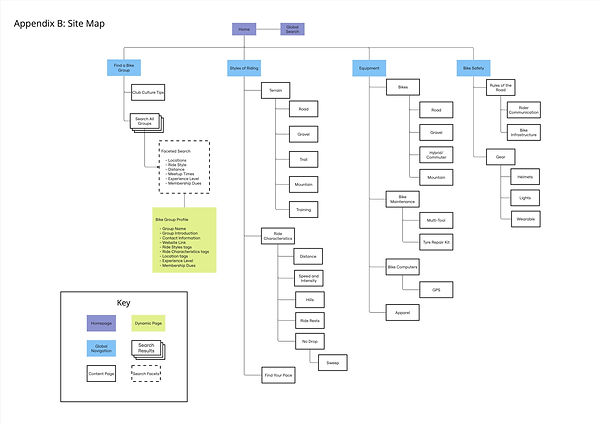
Site structure
Primary Navigation Categories:
-
Find a Bike Group - Core search functionality with faceted filtering
-
Styles of Riding - Educational content with hierarchical organization
-
Equipment - Practical guidance for group participation
-
Bike Safety - Essential knowledge for group riding
Key Structural Decisions:
-
Grouped terrain and ride characteristics under unified "Styles of Riding" parent
-
Separated culture tags as informational (not filterable) due to subjective nature
-
Implemented progressive disclosure through parent-child page relationships
Wireframing
Faceted Search Strategy:
-
Visible filter categories with instant results updating
-
Multi-select checkboxes for complex preference combinations
-
Result count display to show filter impact
-
Pagination for performance and comparison
Culture Information Handling:
-
Limited to 3 pre-selected descriptive tags per group
-
Non-filterable to avoid false precision with subjective attributes
-
Sourced from actual group self-descriptions


ELEVATING USER-CENTERED DESIGN
Validation
Wireframe Usability Testing (n=3)
Participants: Cyclists with no current group membership
Method: Think-aloud protocol with task-based scenarios
Key Findings:
Educational Content Success:
-
100% task success rate for finding trail riding information
-
Effective parent-child categorization resolved previous confusion
-
Context-setting content improved user comprehension
Search Functionality Insights:
-
Users expected filter application buttons (addressed with result count feedback)
-
Domain terminology needed explanation (recommendation: info icons with tooltips)
-
Contact information priority higher than anticipated
Multi-path Navigation Validation:
-
67% used page CTAs, 33% used global navigation for group search
-
Confirmed need for multiple discovery routes
Design Iterations
Pre-testing Issues → Solutions:
-
Added result count display for filter feedback
-
Planned info icons for technical terminology
-
Recommended direct contact links in addition to website/social links
-
Proposed photo carousel for better culture communication
Future iteration
Immediate Implementation:
-
Add explanatory tooltips for cycling terminology
-
Include direct contact methods beyond website links
-
Implement photo carousels for culture visualization
-
Add member testimonials for authentic culture representation
Advanced Enhancements:
-
Personalized recommendations based on search patterns
-
Integration with calendar systems for ride scheduling
-
Community features for group communication

user research | website design | content management
Designed and built a website from scratch in 2 weeks for a foreign assistance advocacy non-profit.